Chipboard or MDF for a kitchen: which to choose
4 min read
Published on by Stefan Poenaru, Nordic Home Timișoara
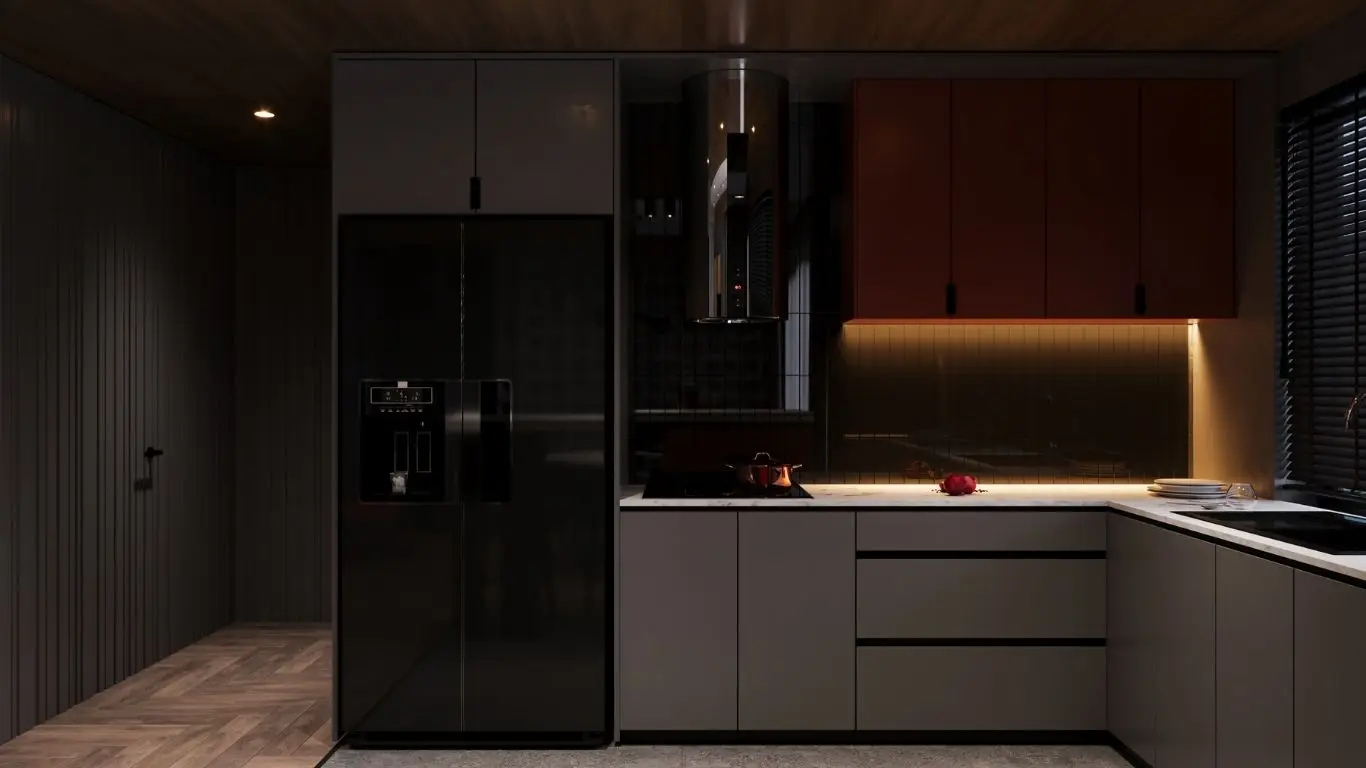
For most kitchens the right answer is "both": carcasses in melamine-faced chipboard and fronts in MDF. That gives you the cheap, stable structure of chipboard and the look of MDF where it is seen and touched.
What chipboard (PAL) is
Chipboard, called PAL in Romania, is a board made of wood chips pressed with adhesive. Furniture almost always uses melamine-faced chipboard: the board is covered on both sides with a hard decorative film (plain colours, wood or stone effects). The standard thickness for carcasses is 18 mm.
Cut edges are covered with edge banding (an ABS strip glued on hot). A 2 mm edge on the fronts takes knocks much better than a thin 0.4–0.8 mm one.
What MDF is
MDF is made of very fine wood fibres pressed to a higher density. Because it is uniform, it can be milled (frames, grooves, integrated handles) and painted perfectly smooth, matte or gloss.
In kitchens you will find three versions: painted MDF, foil-wrapped MDF (PVC film pressed onto a milled board, cheaper) and veneered MDF (a thin sheet of real wood over MDF).
Side by side
| Criterion | Melamine-faced chipboard | Painted MDF |
|---|---|---|
| Price | Lowest | Noticeably higher |
| Look | Printed decor, edges with banding | Continuous surface, no visible edge |
| Shapes | Flat panels only | Milling, frames, integrated handle |
| Colours | The manufacturer's range (Egger, Kronospan) | Any RAL or NCS colour |
| Moisture | Weak point: the edges, if the banding is damaged | The paint seals the fibres |
| Repairs | Deep scratches can't be repaired | A front can be repainted |
| Best for | Carcasses, interiors, small budgets | Fronts, handleless kitchens, matte colours |
Hornbach notes that standard MDF is vulnerable to moisture, but painted or moisture-resistant MDF suits a kitchen, because the paint seals the fibres. The same retailer recommends chipboard carcasses with MDF doors and drawer fronts for higher quality.
The price difference, in numbers
The 2026 Brig price guide gives roughly 1,500–2,800 lei/lm for melamine-faced chipboard and 2,800–4,000 lei/lm for painted MDF. For a 3 lm kitchen, MDF fronts usually add a few thousand lei. More on prices in how much a custom kitchen costs.
Where chipboard is the better choice
- When the budget matters most.
- When you want a wood or stone effect: Egger and Kronospan decors look very good and resist scratches.
- For carcasses and cabinet interiors, always.
Where MDF is worth the money
- Matte fronts in a specific colour (sage green, beige, anthracite).
- Handleless kitchens with a Gola profile or push-open doors.
- Framed fronts, classic or shaker style.
Mistakes to avoid
- Chipboard with thin edge banding next to the sink and dishwasher. Water and steam get there first. Ask for 2 mm edging.
- Gloss MDF in a bright kitchen with small children. Fingerprints and fine scratches show. Matte is more forgiving.
- Comparing quotes without knowing the exact material. "MDF" can mean painted, foil-wrapped or just one front; ask for it in writing.
Frequently asked questions
Does chipboard hold up in a kitchen? Yes, if the edges are well banded and the worktop is sealed at the sink. Problems almost always start at the edges, not on the surface.
Can I have chipboard carcasses and MDF fronts? Yes, and it is the most common combination for mid-range custom kitchens.
What do you use? Carcasses in 18 mm Egger or Kronospan melamine-faced chipboard, with fronts of your choice: chipboard, painted MDF, foil-wrapped MDF or veneer. We pick the right option at the free measuring visit.