Which kitchen worktop to choose: types and prices
4 min read
Published on by Stefan Poenaru, Nordic Home Timișoara
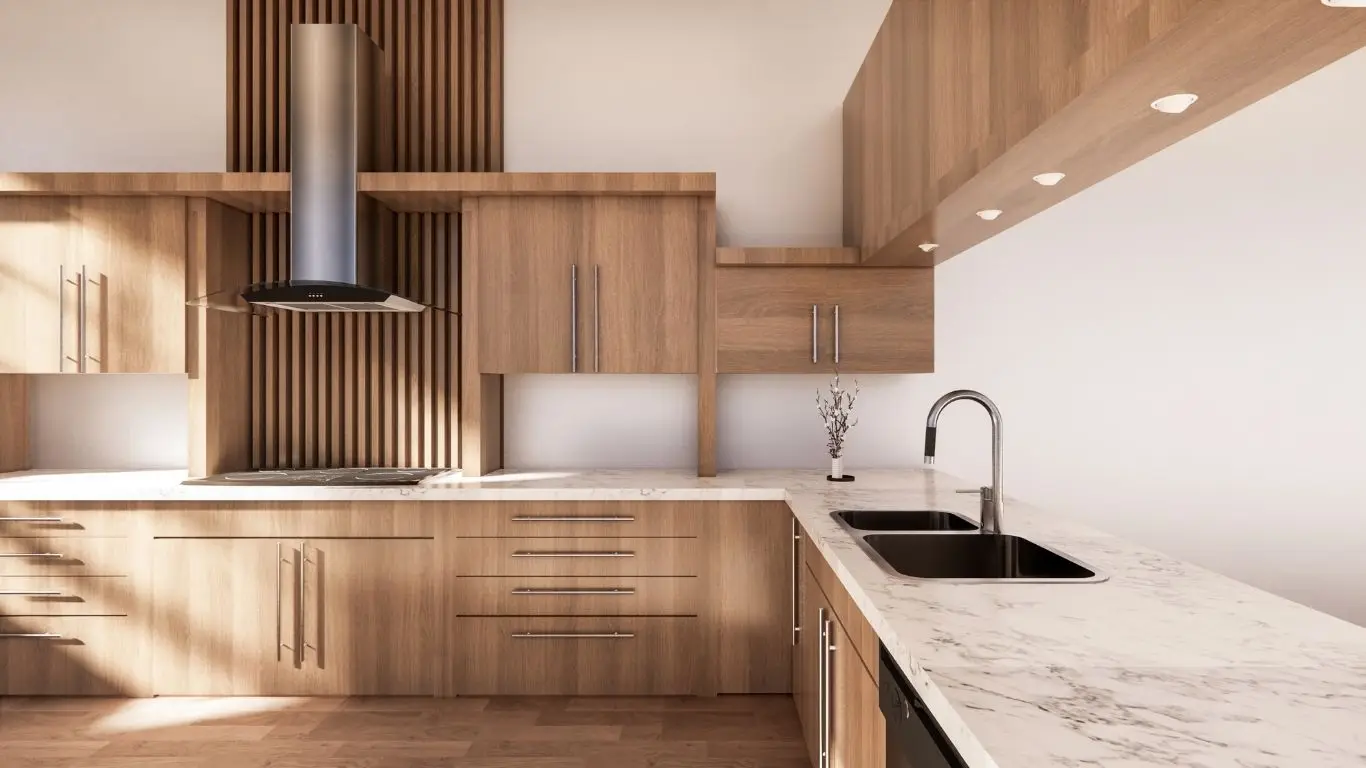
The worktop is the part of a kitchen that wears fastest, so it is worth choosing by how you cook, not just by looks. In short: chipboard is the cheapest, compact offers the best strength for its thickness, quartz resists scratches and stains best, and solid wood is the warmest but needs care.
Indicative prices per linear metre (60 cm wide)
| Worktop type | Price / lm | Usual thickness |
|---|---|---|
| Melamine / postformed chipboard | 80–200 lei | 28–38 mm |
| Solid wood (oak) | 180–350 lei | 26–40 mm |
| Natural granite | 400–900 lei | 20 mm |
| Compact HPL | 400–1,280 lei | 12 mm |
| Quartz composite | 500–1,500 lei | 20 mm |
The ranges are those published by Brig, which also lists the hob or sink cut-out separately (100–300 lei). As a store reference, a 4.1 m × 60 cm × 38 mm chipboard worktop costs 539 lei at Hornbach, about 131 lei/m. The price of solid wood varies a lot by species and joint type; ask for a specific quote.
Postformed chipboard
A chipboard panel covered with laminate, with a rounded front edge ("postformed") so water can't get into the joint. It comes in hundreds of decors, including stone and wood effects.
- Pros: cheapest, easy to replace, lots of decors.
- Cons: cut-outs and joints must be sealed perfectly; if water gets into the chipboard, the board swells. Don't put hot pans directly on it.
- For: small budgets, rental apartments, kitchens used rarely.
Compact HPL
A thin board (12 mm), solid all the way through, made of layers of paper pressed with resins. It has no core to absorb water.
- Pros: resists water and moderate heat, very modern thin profile, the sink can be mounted under the worktop.
- Cons: more expensive than chipboard; deep scratches can't be sanded out.
- For: modern kitchens, handleless fronts, anyone who wants a thin, practical worktop.
Quartz composite
Engineered stone: ground quartz bound with resins, cut and fitted by specialist firms from a template.
- Pros: very resistant to scratches and stains, non-porous, the look of marble without the upkeep.
- Cons: the most expensive; it is measured after the units are installed, which adds 1–2 weeks. It doesn't like hot pans put down directly.
- For: people who cook a lot and want a worktop for 15–20 years.
Granite
Natural stone; every slab is unique. It handles heat very well. It is porous to different degrees, so it needs sealing from time to time.
Solid wood
Oak, ash or walnut staves joined together. It looks warm and can be sanded and re-oiled after years. Wood is sensitive to changes in temperature and humidity, so it needs oiling a few times a year and care around the sink.
How to choose, in three questions
- How much do you cook? Daily and a lot: quartz or compact. Rarely: chipboard.
- Where is the sink? An undermount sink needs compact, quartz or granite; with chipboard the sink sits on top.
- How long should it last? Chipboard: a few years before it shows wear. Compact and quartz: decades.
The worktop is usually not included in the price per linear metre of the furniture. See how it all adds up in how much a custom kitchen costs, and how the thicknesses fit the standard cabinet dimensions.
Frequently asked questions
Which worktop is the most durable? For scratches and stains, quartz. For water and minimal upkeep, compact HPL. For heat, granite.
Can I replace just the worktop, without the furniture? Yes, if the units are level and in good condition. It has to be measured exactly, with the cut-outs for the hob and sink.
Do you handle the worktop too? Yes, we quote it as a separate line so you can compare options. Request a quote.